
Risk Adjustment for Health Plans: What and Why?
- GHIT Digital
- December 19, 2025
- GHIT Digital Insights
- 0 Comments
Risk Adjustment for Health Plans: What and Why for CFOs and Risk Managers
Risk Adjustment is a foundational mechanism in modern healthcare financing, designed to ensure fair and accurate reimbursement by accounting for the health status and risk profile of covered populations. Across Medicare Advantage (MA/MAPD), Affordable Care Act (ACA) marketplace plans, and commercial segments, effective Risk Adjustment directly influences financial sustainability, regulatory compliance, and clinical accuracy. Health plans increasingly rely on – Integrated clinical data platforms; Advanced analytics and machine learning; Natural language processing for unstructured data; Workflow orchestration and automation; Embedded compliance and audit controls. These capabilities help move Risk Adjustment from a retrospective activity to a proactive, insight-driven function.
The Strategic Importance of Risk Adjustment
Risk Adjustment aligns payments with member acuity and clinical complexity. Conversely, inaccurate or incomplete risk capture can result in revenue leakage, audit exposure, and misaligned care strategies. Accurate risk capture helps health plans:
- Enable equitable reimbursement
- Maintain regulatory compliance
- Reflect true population health burden
- Support value-based care models
Key Challenges in Risk Adjustment
Health plans commonly face the following challenges. These challenges often span organizational boundaries—clinical, financial, operational, and technical.
- Delays in encounter data submission
- Fragmented clinical and claims data across systems
- Inconsistent clinical documentation and coding practices
- Increasing scrutiny from regulatory audits (e.g., RADV)
- Limited real-time visibility into Risk Adjustment Factor (RAF) performance
- Manual, labor-intensive chart review processes
End-to-End Risk Adjustment Workflows
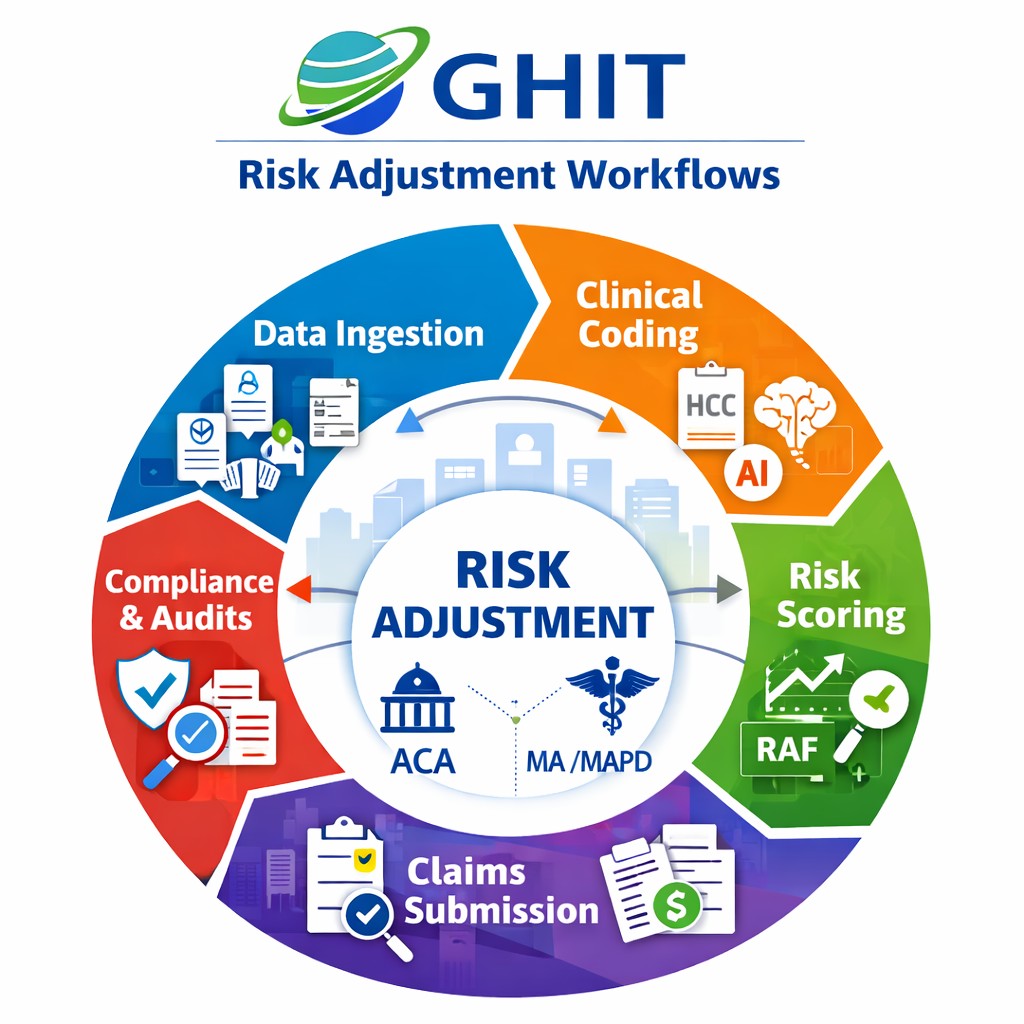
A comprehensive Risk Adjustment lifecycle typically includes but not limited to:
- Data Ingestion: Claims (medical and pharmacy) I Electronic health records (EHRs) I Provider-submitted documentation I Laboratory and diagnostic data I Social determinants of health (particularly for ACA populations)
- Clinical Coding and Validation: Identification of conditions relevant to HCC models I Validation of diagnoses against clinical evidence I Ensuring coding specificity and completeness
- Risk Scoring and Analytics: Calculation of RAF scores I Trend analysis across populations I Forecasting and scenario modeling
- Claims Submission and Reconciliation: Encounter submission to CMS or exchanges I pre-and post-submission edits I Resolution of discrepancies
- Compliance and Audit Readiness: Documentation traceability for each reported condition I Support for RADV and ACA audit processes I Reporting aligned with regulatory guidelines
Risk Adjustment in Medicare Advantage (MA/MAPD)
In Medicare Advantage, RAF scores directly influence CMS capitation payments. Small variations in risk scores can translate into significant financial impact. Key considerations include but not limited to:
- Accurate capture of chronic and hierarchical conditions
- Longitudinal member health profiling
- Ongoing monitoring of RAF trends
- Timely and complete encounter data
Risk Adjustment in ACA Marketplace Plans
ACA Risk Adjustment redistributes funds among issuers based on relative risk. Effective ACA Risk Adjustment requires robust analytics and defensible data models. Distinguishing factors include but are not limited to:
- Benchmarking against peer issuers
- Increased relevance of social and environmental factors
- Population volatility
- State and federal model variations
Stakeholder POV on Risk Adjustment for Health Plans
- Chief Financial Officer (CFO) – Predictable revenue forecasting I Reduced payment volatility I Minimized audit exposure
- Clinical Leadership (CMIO, Medical Directors) – Accurate representation of member acuity I Alignment between documentation and care delivery I Support for quality improvement initiatives
- Technology and Data Leaders (CIO, CDO) – Integrated clinical and financial data platforms I Scalable analytics and reporting capabilities I Strong data governance and security
Conclusion
Risk Adjustment is no longer a back-office exercise—it is a strategic capability that touches finance, clinical operations, and technology. Health plans that invest in integrated workflows, high-quality data, and advanced analytics are better positioned to improve accuracy, reduce risk, and support sustainable growth. This neutral overview is intended to inform strategic discussions and guide thoughtful investment in Risk Adjustment capabilities across the healthcare payer ecosystem.